
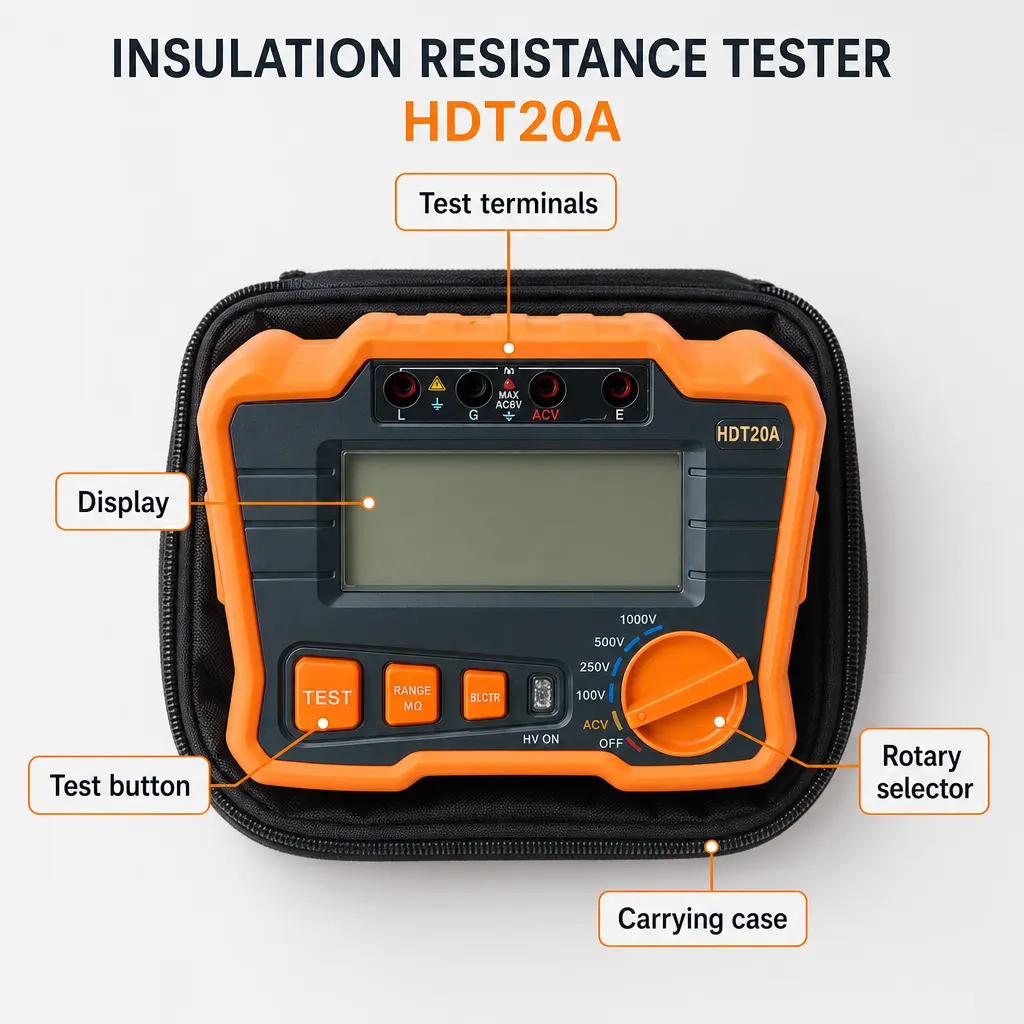
Short answer: When comparing an insulation resistance tester in the UK, begin with the test procedure and safety controls, then check whether the instrument documentation covers the required voltage, resistance range, leads, markings and calibration. Insulmeter lists the Hongda HDT20A Digital Insulation Resistance Tester, Orange, and the product title identifies it as a 1000V digital model. The live page does not publish accuracy, selectable test voltages, resistance range, safety category, maximum working voltage, conformity information or a manufacturer manual. HSE guidance supports planned work, secure isolation and competent operation, so a retail title cannot stand in for technical evidence.
The UK buying question is more than voltage
A UK buyer may be comparing instruments for a workshop, maintenance team or contractor. In each case, the relevant question is whether the documented instrument fits the exact test and safe system of work. A 1000V label is one part of that decision; it does not tell you how the tester should be connected, what it can measure or where it may be used.
The current listing identifies a Hongda HDT20A orange model and a 1000V digital insulation resistance tester. The manufacturer does not specify the complete technical boundary on the written product page.
| Check before ordering | Why it matters | Status on the current page |
|---|---|---|
| Required test voltage and range | Must match the written test method | Not published in full |
| Category and maximum working voltage | Defines the safety boundary for the task | Not published |
| Leads, probes and discharge instructions | Affects connection and safe completion | Not published |
| Calibration and conformity information | Supports traceability and purchasing assurance | Not published |
Use a safe UK selection sequence
HSE says electrical work should be planned and equipment should be suitable for the task and environment. It also says sources of energy should be isolated and people should be competent. Treat those statements as part of the buying checklist, not as boilerplate after the product has already been chosen.
- Write down the equipment, test purpose and acceptance rule.
- Identify the required output, range, environment and lead arrangement.
- Obtain the exact model manual and compare each field with the procedure.
- Confirm isolation, supervision and result-recording arrangements.
- Pause the order if a required safety or performance field remains unknown.
Read the missing facts as a boundary
The current written page does not publish accuracy, selectable test voltages, resistance range, safety category, maximum working voltage, conformity information, lead construction, display behaviour, calibration or a manufacturer manual. The manufacturer does not specify those points. The absence is not proof that the instrument lacks them, but it is proof that the buyer cannot verify them from this page.
When another instrument is the safer choice
Choose a better-documented instrument when the job depends on a precise range, a known category, a stated maximum working voltage, traceable calibration or model-specific operating instructions. HSE also notes that specialised electrical equipment should be inspected and tested by someone with specific competence. A cautious UK purchase is one that leaves fewer safety-critical assumptions.
Related guides and product details
Use the HDT20A as a candidate, then order only when its exact documentation matches the UK task, isolation process and competent-person requirements. Read 1000V Insulation Resistance Tester: What to Verify for related guidance. Read Digital Insulation Resistance Tester for Electricians for related guidance. Review the documented specification on the Hongda HDT20A Digital Insulation Resistance Tester, Orange product page before ordering.
Sources and safety context
- Supports the HDT20A identity, orange SKU and 1000V title wording. Current Insulmeter product page.
- Supports planning, secure isolation, suitable equipment and competence. HSE: Work on electrical equipment, machinery or installations.
- Supports specific competence for specialised electrical inspection and testing. HSE: Frequently asked questions on electrical safety.